
Santa Rosa Previous Residents: Era Coverage
A single Santa Rosa address can leave several kinds of evidence. Sonoma County's ordinary recorder index begins in 1964, but earlier grantor and grantee indexes, office volumes, and recorded images extend the trail much farther back. Directories and census schedules identify people associated with an address, while deeds identify parties to a recorded instrument. Newspapers, Sanborn maps, and permits add context about a building and its changes.
The table separates the main evidence layers. “Previous residents” can mean a deed owner, a listed occupant, or a household counted on a census date, so no single row should be treated as a complete resident list.
| Source | Years It Covers | Where Held | What It Shows |
|---|---|---|---|
| Recorder ordinary index | 1964-present | Sonoma County Official Public Records | Indexed parties, document type, date, and number |
| Grantor-grantee index | 1830-1963; office volumes back to 1835 | Recorder historical index and office | Earlier party references for a deed chain |
| Recorded images | 1835-1979 microfilm/digital; 1980-present computer | Recorder office and copy channels | Legal descriptions and instrument terms |
| Directories | 1870s-early 1950s | Sonoma County History & Genealogy Library and digital collections | Listed residents, businesses, occupations, and addresses |
| Federal census | 1850-1950 public schedules | NARA and library databases | Households at a census date |
| Newspapers | 1857 forward; Press Democrat 1897-1969 | History & Genealogy Library | Obituaries, notices, addresses, and local events |
| Sanborn maps | 1893, 1897, 1908, 1954-57 | History & Genealogy Library and FIMo | Building footprint, use, construction, and numbering context |
| City permits | Coverage start unverified | Santa Rosa permit systems | Work, status, inspections, plans, and project dates |
The Sonoma County Official Public Records index is the practical start for a recent deed, but an older address needs the historical index, library shelf, or office counter. The era table keeps a missing result from being mistaken for proof that no former resident or owner existed.
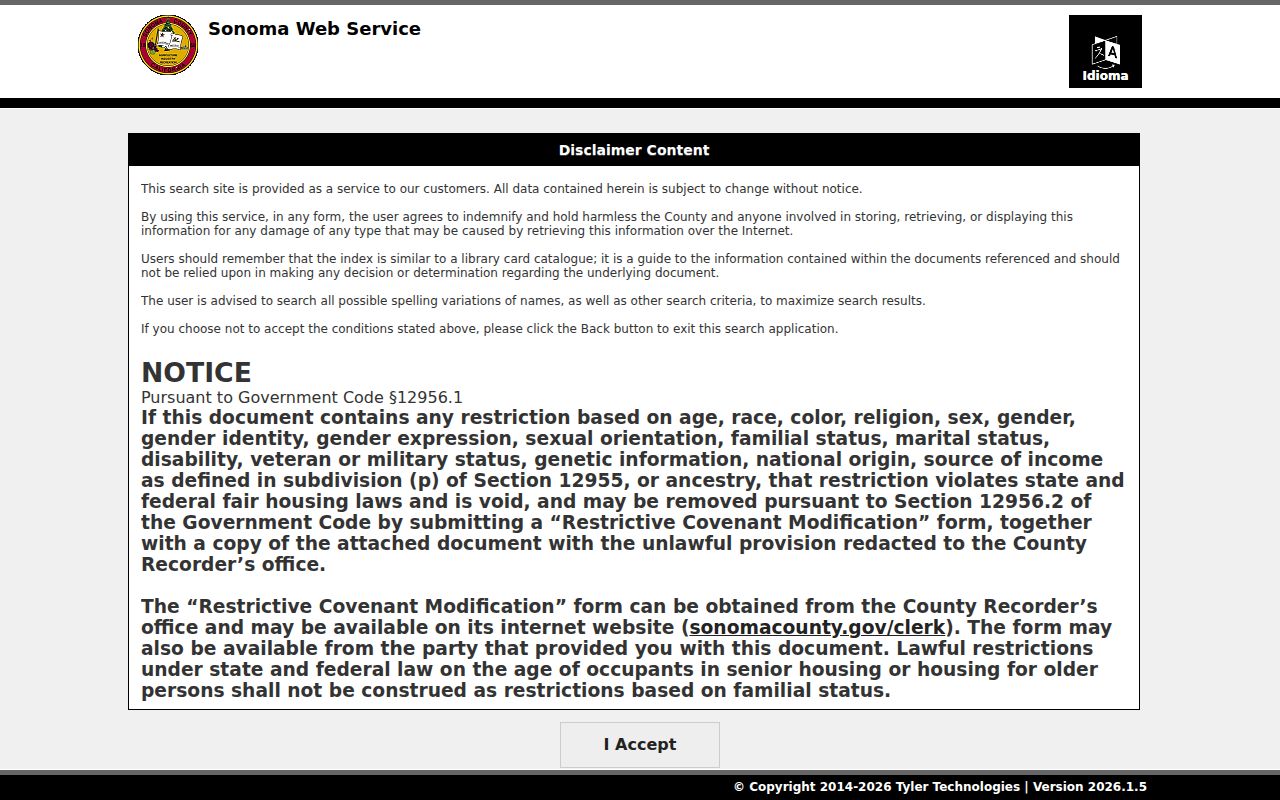
The recorder screen is a finding aid, much like a library card catalog. It points to a document; the recorded image and its legal description supply the detail needed for a reliable backward trail.
Note: The ordinary index is a finding aid, not proof of a deed's contents; the recorded image and legal description carry the detail.
Santa Rosa Previous Residents: Fee Parcel
Begin with the physical address, or situs, rather than a person’s name. The Sonoma County Assessor Parcel Search accepts a fee parcel, assessment, or street address. In the address mode, the search tips call for the street number and name without a full street-type word, and they use W for West. The result can return an APN, basic parcel information, assessment-roll data, notices, and a parcel map.
The Internet assessor result does not show owner names. The assessment roll can be viewed at the office, where assessed-owner and mailing facts may be available. That assessed owner is not automatically the current legal owner because assessment updates can lag recorded instruments. A tax-mailing address is not proof that a person lived at the parcel, either. Use the online result to capture the APN and map references, then move to the roll and recorder.
Santa Rosa Deed Chain for Previous Residents
The deed chain turns one address into a sequence of recorded parties. After the assessor supplies the APN, inspect the office assessment roll for the assessed owner, then search that name in the recorder index near the likely purchase period. The recorder is indexed by party, not reliably by street address, so the owner-name bridge is essential. Search variants matter because older entries may abbreviate names differently.
Once the purchase deed is found, read the grantor, grantee, recording date, document number, and full legal description. The seller is the next backward search target. The process is strongest when the legal description stays continuous while names and document dates move from one transfer to the next.
- Search the assessor by street address and save the APN, situs, map link, and any legal or parcel-map reference.
- Inspect the assessment roll for the assessed owner and mailing information available at the county counter.
- Search the recorder's 1964-present index for that name and the likely recording period, allowing for historic abbreviations.
- Open or order the purchase instrument, then record its grantor, grantee, date, document number, and legal description.
- Search the grantor as an earlier grantee and repeat the comparison with the same legal description.
- For pre-1964 transfers, move to the digitized 1830-1963 grantor-grantee index or the office volumes that reach back to 1835.
- Grantor and grantee
- The grantor transfers an interest; the grantee receives the interest named in the instrument.
- Chain of title
- The linked sequence of recorded transfers used to follow the same land through time.
- Legal description
- The formal land description in a deed. It can remain useful when a street address or APN changes.
Santa Rosa Recorder Quirks in Old Records
The ordinary online recorder index covers 1964-present. That is a search boundary, not a property-history boundary. Sonoma County links digitized grantor-grantee indexes for 1830-1963, and the research notes office volumes back to 1835. Recorded images from 1835-1979 are held on microfilm and digital systems, while 1980-present images are on computer. The wording differs slightly between the index and office descriptions, so preserve both dates when planning a search.
Names also change shape across the index. In 1964-1990, the first word of a name was abbreviated in examples such as SEC PAC NATL BK. From 1990, later words may still be shortened. Beginning January 1, 2010, staff stopped abbreviating unless the instrument itself used an abbreviation. A broad search with spelling and abbreviation variants is safer than one exact phrase.
The official public record copy instructions explain why a document number matters before an order is placed.
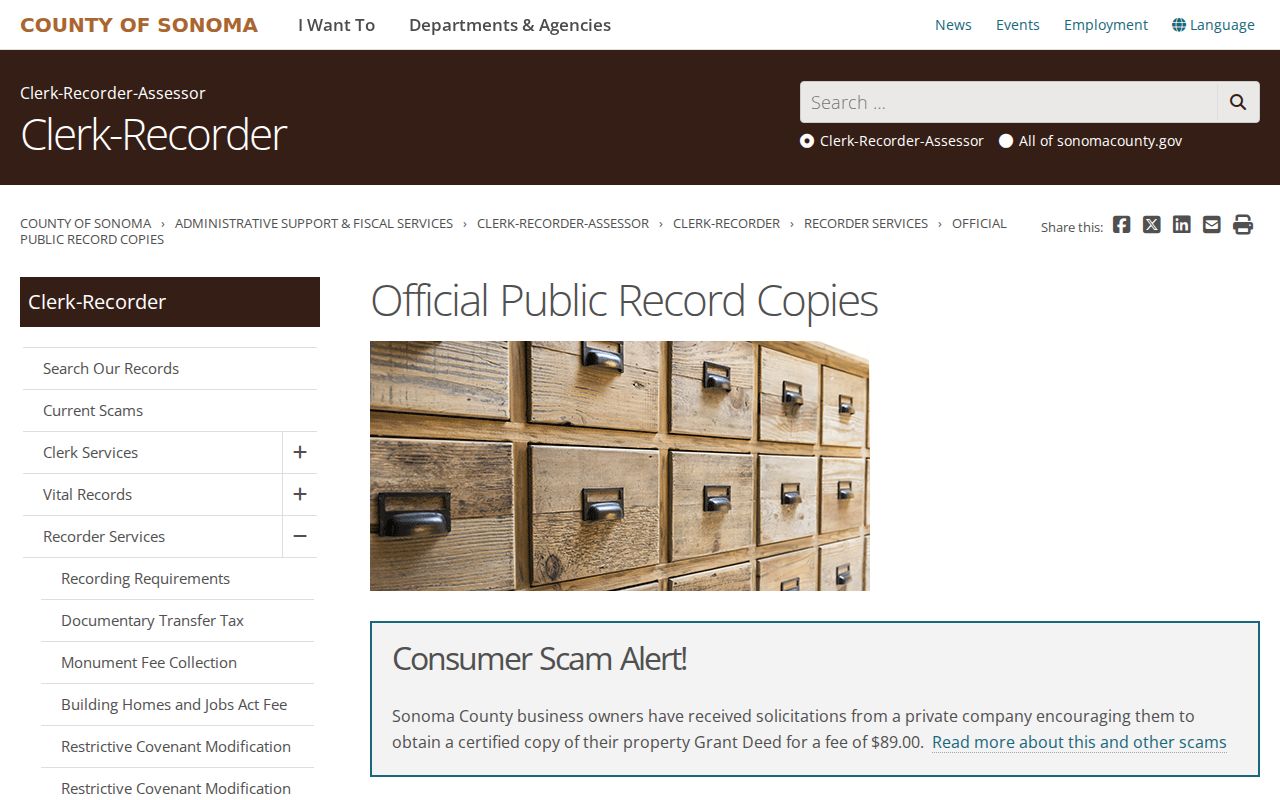
Copies are not a title-search service. The recorder does not decide which deed a researcher needs, so the party names, approximate date, and document number should be gathered first.
The available channels have different limits and prices. Online inspection starts with the index disclaimer, and free image inspection is available at the office, but electronic or certified copies carry charges.
| Channel | Coverage or condition | Charge or requirement |
|---|---|---|
| Online download | 1964-present, identified document | $4 per document plus $2 card convenience per transaction |
| Online certified mail order | Identified document, not a download | $4 per document certification plus copy or order charges stated by the system |
| Counter | Images and maps can be viewed free | $5 per page; certification $4 per document; card convenience $2.50 |
| 1964-present only when under 10 pages | $6 per document; pre-1964 $6 per page; no certified email copies | |
| Identified document number | $5 per page plus $4 certification |
The recorder fee schedule should be checked before payment. The office is at 585 Fiscal Drive, Room 103, Santa Rosa, with 707-565-3800 and ClerkRecorder@sonomacounty.gov; document processing stops during the final 30 minutes of the business day.
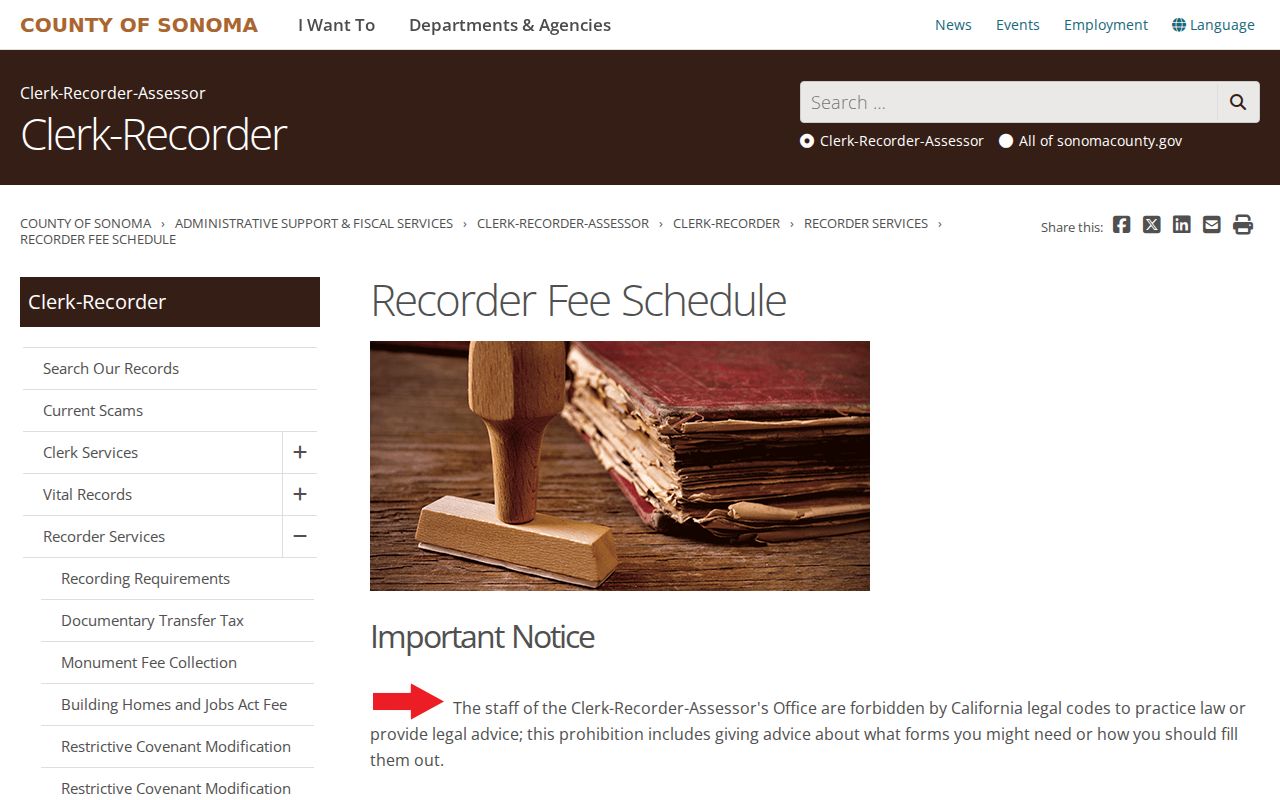
The fee schedule image is useful for comparing a quick index inspection with a paid copy. A known document number keeps the request narrow and avoids paying for an office search that the recorder does not perform.
Legal Descriptions and Santa Rosa Past Residents
An APN is a bridge between the assessor, a map, and later records, but it is not permanent land identity. Subdivisions and parcel mergers can change the number. A deed’s legal description, parcel map, subdivision reference, or metes-and-bounds language gives the chain a firmer anchor than a street label alone. Compare the description on every instrument before treating two names as part of one property history.
Situs, mailing address, and legal description answer different questions. The situs identifies the land. The mailing address routes tax correspondence. The legal description identifies the interest transferred. If the same person appears in a directory and on a deed, that is a useful lead, not automatic proof of occupancy. For current parcel-to-parcel work, the address-keyed method on the Santa Rosa street directory page supplies the next map and parcel steps.
Santa Rosa Previous Residents in Directories
Deeds name parties to transfers; directories and census schedules are the household layer. Sonoma County’s digitized directory range runs from the 1870s into the early 1950s. Verified local examples include Santa Rosa volumes from 1903, 1908, 1911-13, 1915-20, and 1918, the Polk-Husted 1909-10 volume, the Press Democrat 1924 directory, and Pacific Telephone and Telegraph issues from 1921 through the 1930s. Entries can show a name, occupation, business relationship, and street address. The History & Genealogy Library is at 725 Third Street, Santa Rosa, and is open Tuesday-Saturday 11-5 for noncirculating materials, microfilm readers, and scanners.
Address sections are issue-specific. No exhaustive official reverse or criss-cross run was verified, so do not assume that every directory supports an address search. The library’s item viewer may offer search text, transcripts, contents, and downloads, but OCR can misread surnames. The broader collection and its access notes are organized in the Santa Rosa directory book collections.
Pair a directory hit with a census date rather than calling every listed name a permanent occupant. The 1950 schedule is the latest fully public federal decennial census under the 72-year rule as of the research date. A gap can mean a move, death, omission, or a publication gap.
- Search the scanned directory text, then inspect the page image for initials, abbreviations, and surname spelling.
- Write down the printed name, address, occupation, and directory year before opening another volume.
- Check adjacent years and both alphabetical and business sections for a move or partnership.
- Compare the address with the closest public census schedule, then separate household members from deed parties.
- If an entry disappears, search local newspapers, probate notices, permits, and later deeds for a reason.
Santa Rosa House Records on Sanborn Maps
Sanborn fire-insurance maps help place a structure in its block and its era. The local holdings include 1893, 1897, 1908, and 1954/1957 maps. They can show a building footprint, use, construction notes, and address or numbering context. That evidence helps test whether a deed, directory entry, or newspaper notice refers to the same structure, especially when a parcel has been split or a street label has changed.
Maps do not identify every household. Use them to compare the land and building, then return to the deed, directory, census, or newspaper source for people. The 1906 earthquake altered downtown buildings and business evidence, so a later address may not match an earlier building footprint without checking the map layer.
Assessor aerial photographs at the History & Genealogy Library add another date layer: 1961, 1971, 1980, a page that also says 1900 and should be verified as a possible typo, and 2000. Aerials can show neighborhood or property change, but they do not prove who occupied a house. The library’s Researching Your Historic Property guide pairs directories with permits, registers, cemetery, vital, probate, yearbook, and archive sources.
Santa Rosa Permit Records and Past Residents
Permit history can date an addition, demolition, rebuild, grading work, tree removal, subdivision, or other change that explains why an address looks different across time. Permit Santa Rosa Search accepts a permit number, permit and sub-type choices, status, location, title keyword, address, and date range. Basic searching is free, while login and watch-list functions add account tools. The documented coverage start is unverified, so an empty result is not a reliable first-year date.
The newer city account portal adds payment, applications, and wider modules for building, enforcement, engineering, property information, fire, planning, recreation and parks, and water. For a past-resident trail, use the public address search first, then inspect any linked plan, certificate, notice, or resolution. A Santa Rosa mailing address can still describe land outside city limits, so a result that routes the parcel to the county permit office must be followed there.
- Use the address and date range to find a project window.
- Read the permit type and status before treating a record as completed work.
- Compare the project address with the APN and legal description.
- Use plans, inspections, and notices as property evidence, not as proof of current occupancy.
Note: Permit coverage begins at an unverified point, so an empty result does not date a property's first work.
Santa Rosa Previous Residents: Obituaries and Probate
When a directory entry stops, local newspapers may explain the change. The History & Genealogy Library holds Press Democrat microfilm from 1897-1969 and other Santa Rosa newspaper runs reaching back to 1857, though the runs have gaps. Obituaries, marriage notices, civic items, addresses, and sale or estate notices can connect a name to an earlier address. Use the printed notice as a lead and compare its date and relationships with a deed or vital record.
Probate files can add heirs, petitions, notices, and property references after a death. The Sonoma Superior Court Odyssey portal requires a free account and Registered Public approval; party searches accept a case number or a Last, First, Middle name format, with an asterisk wildcard for partial names. Remote document access varies, and sealed, juvenile, adoption, and other confidential records remain outside an open name search. The court records route also supports written and in-person requests when the online result is not enough.
Records requests can go to 625 Administration Drive, Santa Rosa, at 707-521-6670, Monday-Friday 8-3:30. Mail requests need a self-addressed stamped envelope and a check payable to the court, so a known case or document keeps the request focused.
The Sonoma County Clerk-Recorder services connect recorded land instruments with birth, death, marriage, fictitious-business-name, and notary filings held by the county office.
The services image points to the custodian rather than a broad compilation. A family-history or heir question is stronger when newspaper language, probate entries, and official copies agree on the same person and address.
House-history use. Previous-resident research fits family history, genealogy, an estate or heir question, and personal study. Do not use names or addresses to stalk, harass, threaten, or expose a protected person.
Roseland Geography and Santa Rosa Past Residents
Jurisdiction can break an otherwise careful address history. Santa Rosa is both an incorporated city and Sonoma County’s seat, but a Santa Rosa postal address does not prove that the parcel is inside the city. The official Roseland annexation account describes roughly 714 acres in five formerly unincorporated islands: Roseland, Victoria Drive, West Hearn Avenue, Brittain Lane, and West Third Street. The listed addresses already used Santa Rosa and ZIP codes 95401 or 95407 before incorporation.
For previous residents, preserve the jurisdiction at each point in the trail. City permit records, county assessment material, recorder instruments, library directories, and newspaper notices may all describe the same land through different custodians. A postal city can stay the same while the permit office changes. That geography lesson is also a safeguard against assigning a county record to the wrong municipal system.
The Sonoma County Archives catalog is a useful fallback for older county, court, permit, map, photograph, and project material. Its search supports keywords, Boolean operators, record type, fields, and year ranges; offsite boxes may need a request five business days ahead. Earlier records and past residents are often found by combining the archive, library, recorder, and map layers rather than repeating one online search.