
Santa Rosa City Directory Collections
The verified collection story is broader than one publisher. The Sonoma County History & Genealogy Library and its digital collections hold residence, business, telephone, map, and newspaper material. The table distinguishes a collection's verified years from an assumption that every annual issue survives. Where a collection record does not confirm an exhaustive run, the gap is stated plainly.
| Collection | Years | Where Held | Access |
|---|---|---|---|
| Digitized Sonoma County directories | 1870s to early 1950s, broad range | Sonoma Library Digital Collections | Scans or excerpts; item search, transcripts, contents, downloads |
| Polk-Husted Santa Rosa, Petaluma & Sonoma County | 1909-10 | Direct digital item viewer | Names, occupations, business and street addresses |
| Press Democrat directory | 1924 | Direct digital item viewer | Countywide city, business, and residence entries |
| Pacific Telephone & Telegraph cluster | 1921 through 1930s | Digital document library | Three-county telephone listings; early issues customized for Petaluma |
| Santa Rosa directory examples | 1903, 1908, 1911-13, 1915-20, 1918 | Library authority records | Photographer addresses, businesses, and partnerships |
| Sanborn fire-insurance maps | 1893, 1897, 1908, 1954/1957 | History & Genealogy Library and FIMo | Building footprint, use, construction, and address continuity |
| Press Democrat microfilm | 1897-1969 | History & Genealogy Library | Obituaries, announcements, addresses, and local events |
| Other Santa Rosa newspapers | 1857 onward, broken runs | History & Genealogy Library guide | Earlier decades and gaps in Press Democrat coverage |
Each source answers a different historical question. Residence and business directories are name-centered snapshots. Telephone issues add a listing layer tied to phone service, not proof of every occupant. The Press Democrat directory supplies a countywide city, business, and residence view for 1924, while newspaper microfilm supplies events around a name. Sanborn sheets identify structures and uses, not the people who lived there. That separation matters when a family trail crosses a changing block. A directory address can be a studio, shop, office, or home, and a business partnership can appear without describing the household behind it. Record the source type with every clue.
The collection page does not publish a final printed year or an exhaustive issue list. It also does not verify a continuous reverse or criss-cross run. A missing year can be a publication gap, an uncataloged issue, or a search failure. Treat the verified year ranges as a map of what has been surfaced, not as a guarantee that no other volume exists.
Open Santa Rosa Directory Scans
The Sonoma County directory collection offers full scans or excerpted city sections. An item viewer can expose Search this item, metadata, a summary, contents, transcripts, and download controls. Search the text first, but always turn the page image to check an initial, a street number, and a line break. OCR can turn a surname into a different word, especially in a faint scan.
The digitized directory landing page is the source for this view of the online Santa Rosa collection.
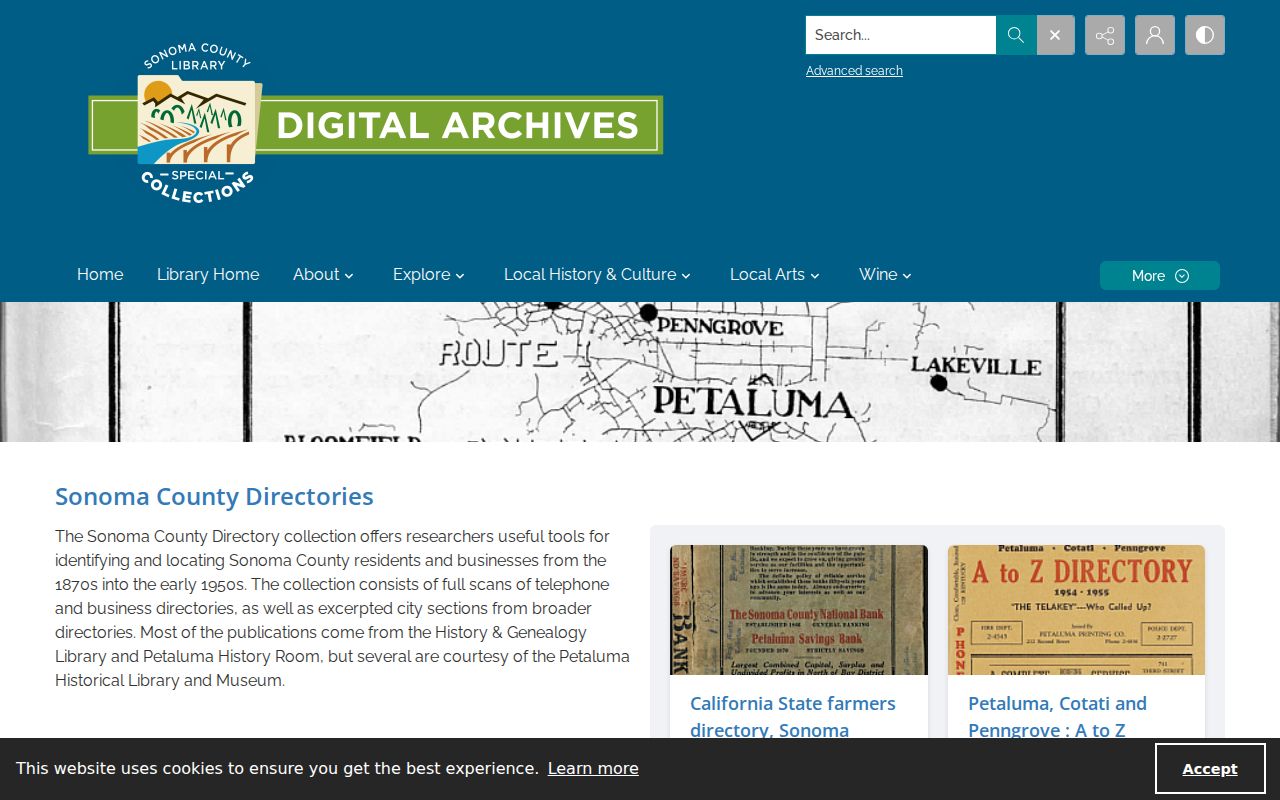
The digitized-collection capture shows the library's online entry point for searching older Santa Rosa directory material.
Some download types may be restricted even when a scan can be viewed. Save the volume title, issue year, page number, and the exact printed form of the name. A stable citation makes a later newspaper or deed check much easier.
The Polk-Husted 1909-10 item viewer gives a concrete example of a named Santa Rosa volume rather than a generic search result.
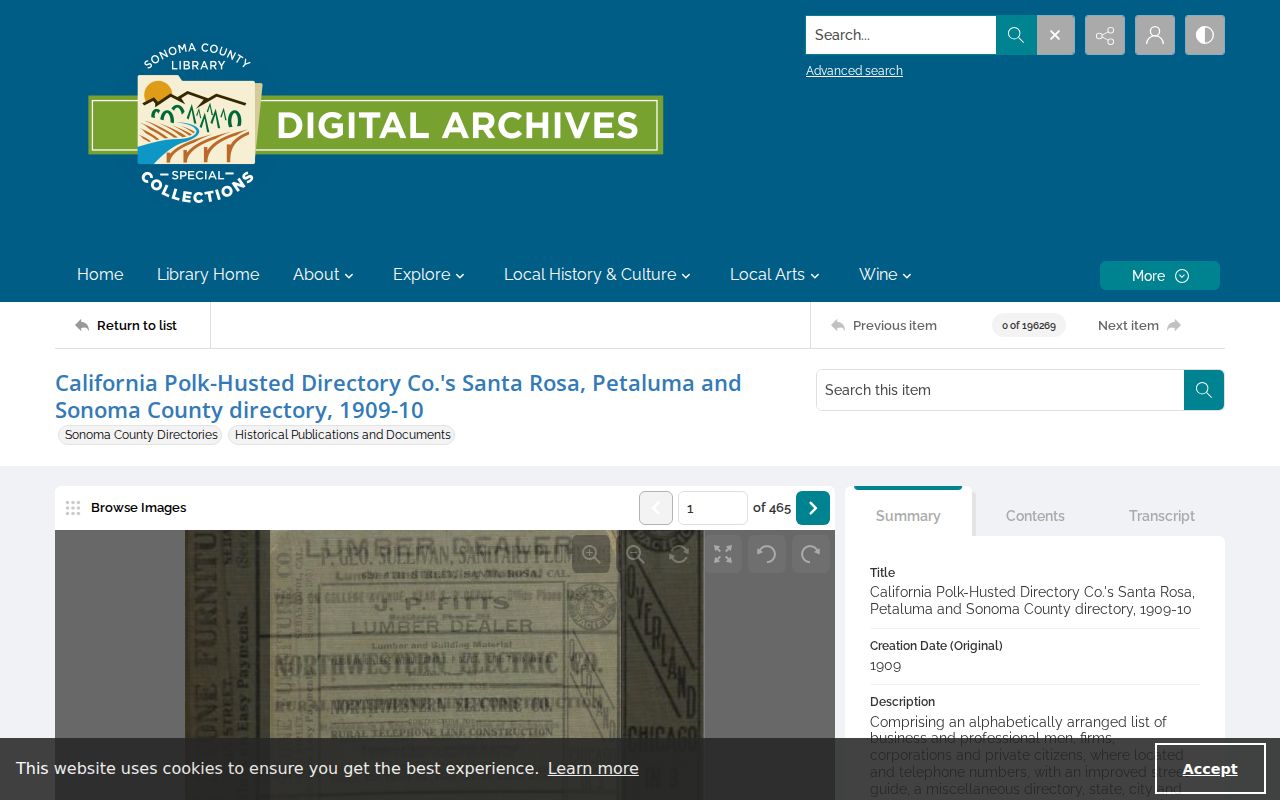
The Polk-Husted capture points to an issue whose names, occupations, and business or street addresses can be checked against the printed page.
Visit the Santa Rosa Directory Shelf
The Sonoma County History & Genealogy Library is at 725 Third Street in Santa Rosa, with 707-308-3212 listed for contact. Posted hours are Tuesday through Saturday, 11 to 5. Materials are noncirculating and used in the library. No-flash photography is allowed, while tripods and personal scanners are not. Researchers have four public computers, a catalog computer, two digital microfilm readers, and photo, document, and overhead book scanners.
Cardholders receive up to $5 per day in printing and copying before posted per-page charges. Ask staff for the catalog record, issue shelf, or newspaper run rather than assuming a missing online scan is missing from the library. The local-history guide also points to maps, photographs, government records, and newspapers that can fill a gap between two directory years.
The History & Genealogy Library local-history holdings are the source for this view and give the physical access context for a Santa Rosa directory search that cannot be completed online.
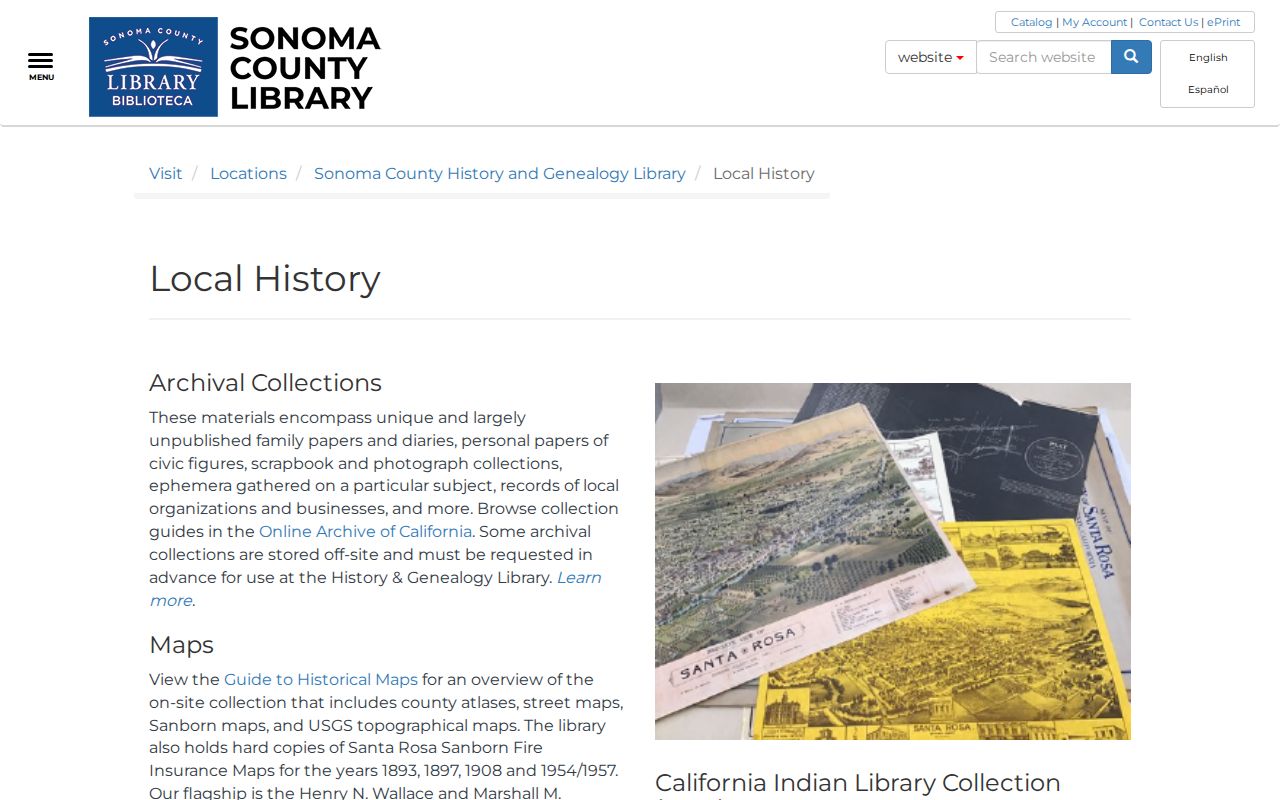
The local-history holdings capture shows why the room matters: a directory can be paired with microfilm news, a Sanborn map, or a photograph of the same block.
Read a Real Santa Rosa Directory Entry
Local samples show what a directory can establish without asking it to prove too much. In the 1903 Santa Rosa Directory, Julius F. Scholz appears as a photographer with a business at 410 Fourth Street. By 1908, his address is 323 Fifth. In 1911-13, he is partnered with William McClearie, and in 1915-20 he owns a gallery. The 1918 volume lists Fred Hartsock, photographer, at 523 Fourth Street. Another entry places O.G. Cummings's home and business at 507 Tucker by 1911.
| Printed name | The person or business as the volume spells it |
|---|---|
| Occupation | The role attached to the entry, such as photographer |
| Address | A business or street address tied to that issue |
| Relationship | A partnership or business connection when printed |
| Year | The issue date that fixes the clue in time |
Spouse-in-parentheses, widow, owner, and renter marks are common directory conventions, but the local samples reviewed did not verify those fields for Santa Rosa. Do not put an unexamined abbreviation or symbol into a family tree. Photograph or transcribe the page and its key before interpreting it.
- Criss-cross directory
- An address-ordered section that can connect a street number to a listed occupant when the issue contains one.
- Householder index
- An index organized around a household or head of household, if that volume supplies one.
- Abbreviation key
- The volume's explanation of shortened occupations, streets, or relationships; locate it before reading entries.
Trace a Household Through Santa Rosa Directories
A directory is strongest when used as a sequence. Begin with the first known name and issue. Record every address and occupation exactly as printed. Search an adjacent year before deciding that a person disappeared. Then pair the directory clue with a public census schedule, newspaper notice, deed, permit, obituary, or probate record.
- Search the digital transcript and inspect the scanned page for the name and address.
- Write down occupation, business relationship, street text, page, and issue year.
- Check the next and prior available Santa Rosa directory, allowing for initials and spelling variants.
- Use an address section only when that volume actually contains one; treat the reverse run as non-exhaustive unless the volume says otherwise.
- Pair each directory era with the federal census, using the 1950 census as the latest fully public decennial schedule in this research.
- Search newspapers, probate, permits, and deeds when an entry ends or an address changes.
A missing entry can mean a move, death, occupation change, publication gap, or simple omission. An obituary can identify relatives and a former address, but the vital or probate custodian remains the stronger source for a formal fact. A directory shows presence in print, not a legal claim to a property.
Use Santa Rosa Telephone Directories Carefully
Pacific Telephone & Telegraph volumes form the largest cluster from 1921 through the 1930s. Some early issues were customized for Petaluma while covering Sonoma, Lake, and Mendocino counties. Read the scope notes before declaring a Santa Rosa name absent. Telephone listings can carry a name and number or business connection, but the issue's geography and publication date determine what an absence means.
The Press Democrat directory from 1924 and the older newspaper runs add another layer. The library's Press Democrat microfilm covers 1897-1969, while other newspapers begin as early as 1857 in broken runs. Search the Democrat, Republican, Herald, and Labor Journal when a directory has a gap.
The library's historic-property research guide is the source for this reference image and connects directories to permits, registers, tax material, newspapers, cemetery files, and probate indexes.
The guide is useful when a Santa Rosa directory entry needs to be tested against a building, parcel, or local family record.
Pair Santa Rosa Directories With Maps
Sanborn maps survive for 1893, 1897, 1908, and 1954/1957. They can place a building footprint, use, construction detail, and address context beside a directory entry. Assessor aerial photographs include 1961, 1971, 1980, a page-labeled 1900 date that should be verified, and 2000. These records are valuable for a house or business whose printed address changes over time.
The Sonoma County Archives catalog holds Board of Supervisors, Permit and Resource Management, court, minutes, actions, projects, reports, photographs, and maps. Catalog searches can use keyword, Boolean operator, record type, field, and from/to year. Some material is offsite. Request box or volume details five business days ahead at history@sonomalibrary.org or 707-308-3212.
The Sonoma State University special collections are the source for this reference image. At 1801 East Cotati Avenue in Rohnert Park, SSU lists 707-664-2375 for contact and holds local material that can add people, roads, buildings, and community history to a directory clue.
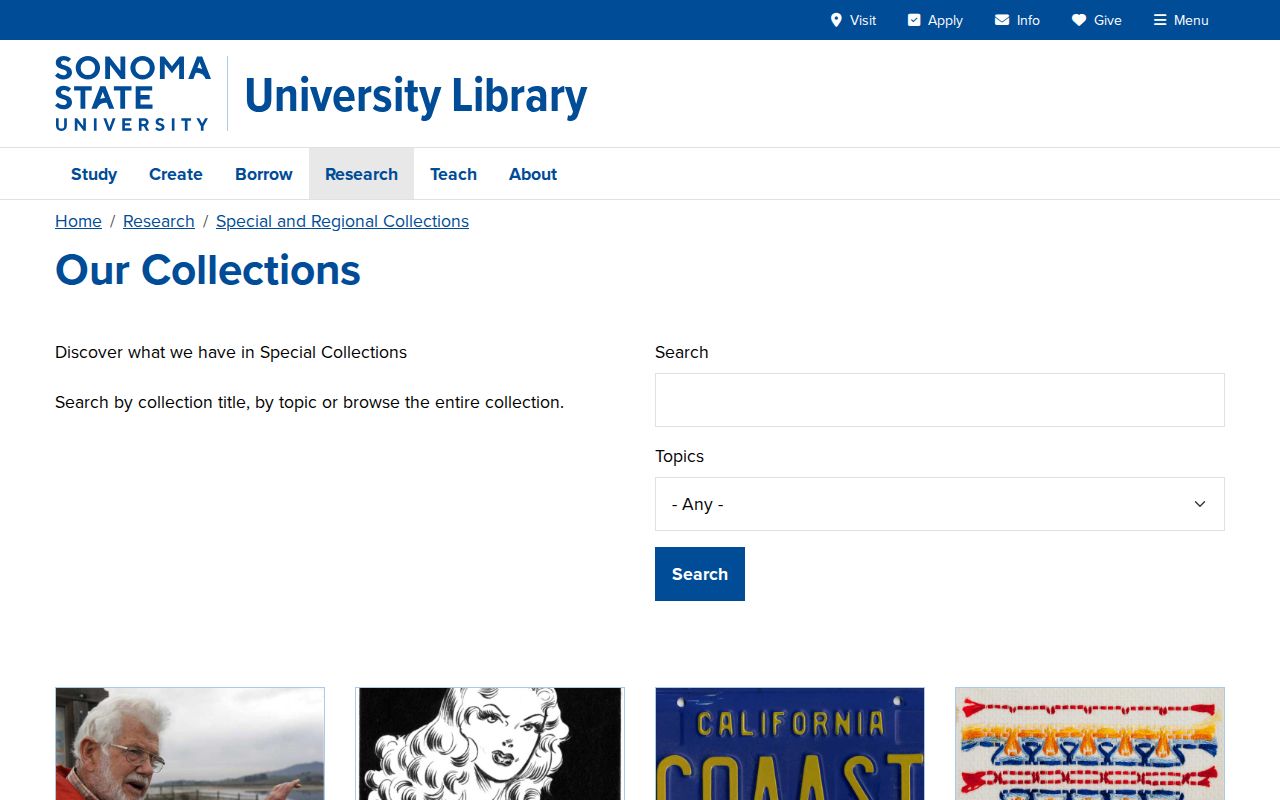
Those holdings include oral histories, migration material, highway right-of-way appraisal files, preservation photographs, and local reporting sources that can extend a Santa Rosa directory search.
Santa Rosa Directory Timeline
A timeline keeps a name, map, or newspaper result in the right historical layer. The dates below are verified touch points, not a claim that the directory shelf is annual or complete.
- 1870s to early 1950s: the digitized Sonoma County directory holdings cover a broad, issue-dependent range of residence, business, and telephone material.
- 1897-1969: Press Democrat microfilm supplies obituaries, announcements, addresses, and local events across a longer, noncontinuous newspaper run.
- 1903-1908: the photographer examples place Julius F. Scholz at 410 Fourth, then 323 Fifth.
- 1909-1924: Polk-Husted covers 1909-10, the Scholz examples and Fred Hartsock add person-level comparisons, and the Press Democrat directory appears in 1924.
- 1921 through the 1930s: the Pacific Telephone & Telegraph cluster supplies three-county telephone listings, with early issues customized for Petaluma.
- 1954/1957: later Sanborn map years complement the 1893, 1897, and 1908 sheets with building and address context.
- 1967 and 1994: the library began as the “Sonoma County Room” in 1967 and moved to its present adjacent building in October 1994.
The sequence still leaves the final printed directory year open. Use it to frame a search, then check the catalog or shelf when a missing year changes the conclusion.
Why Santa Rosa Archives Sit Here
Santa Rosa became the county seat in 1854, and a mule team physically moved the county archives from Sonoma to the new seat. The library began as the “Sonoma County Room” in 1967 and moved into its present adjacent building in October 1994. That history helps explain why a Santa Rosa directory search can lead to county maps, court material, permits, photographs, and newspapers in the same research neighborhood.
The 1906 earthquake destroyed downtown buildings and photographer John Ross's Fifth Street studio. That event can interrupt a business and address trail even though no wholesale destruction of official record books was verified. When a name jumps between locations, test the newspaper and map evidence before assuming a new household.
Santa Rosa City Directory Clues From Cemeteries
A directory entry can become especially useful when a family trail reaches a cemetery but the expected index is incomplete. The city's volunteer handbook says the original burial records for Moke, Stanley, Fulkerson, and Rural Cemeteries were lost. No verified city-run interment-name database was located in the research. Markers, newspapers, library files, and other records therefore matter when a printed name needs a burial or family connection.
Use the directory year to set a search window, then look for a Press Democrat obituary, a local announcement, or a probate reference. A missing burial register is a records gap, not proof that someone was never buried there. The same care applies to a name that disappears from a directory. It may reflect a move, death, publication gap, spelling change, or omission, and the surrounding sources help separate those possibilities.
Know What a Santa Rosa City Directory Omits
The library's collection page does not confirm every issue, a last printed year, or a complete reverse-directory sequence. A person can be absent because the publication did not cover the place, the issue is missing, the name was spelled differently, or the person was not listed. A directory also does not establish a current address or ownership.
Use the Santa Rosa street directory address chain for modern parcel and permit work. Use the historical volume for the printed clue, then verify a material claim with the custodian that holds the deed, court file, vital record, or archive. The directory is a strong bridge between a name and an era when its limits stay visible.